CFU Calculator for Colony Counts
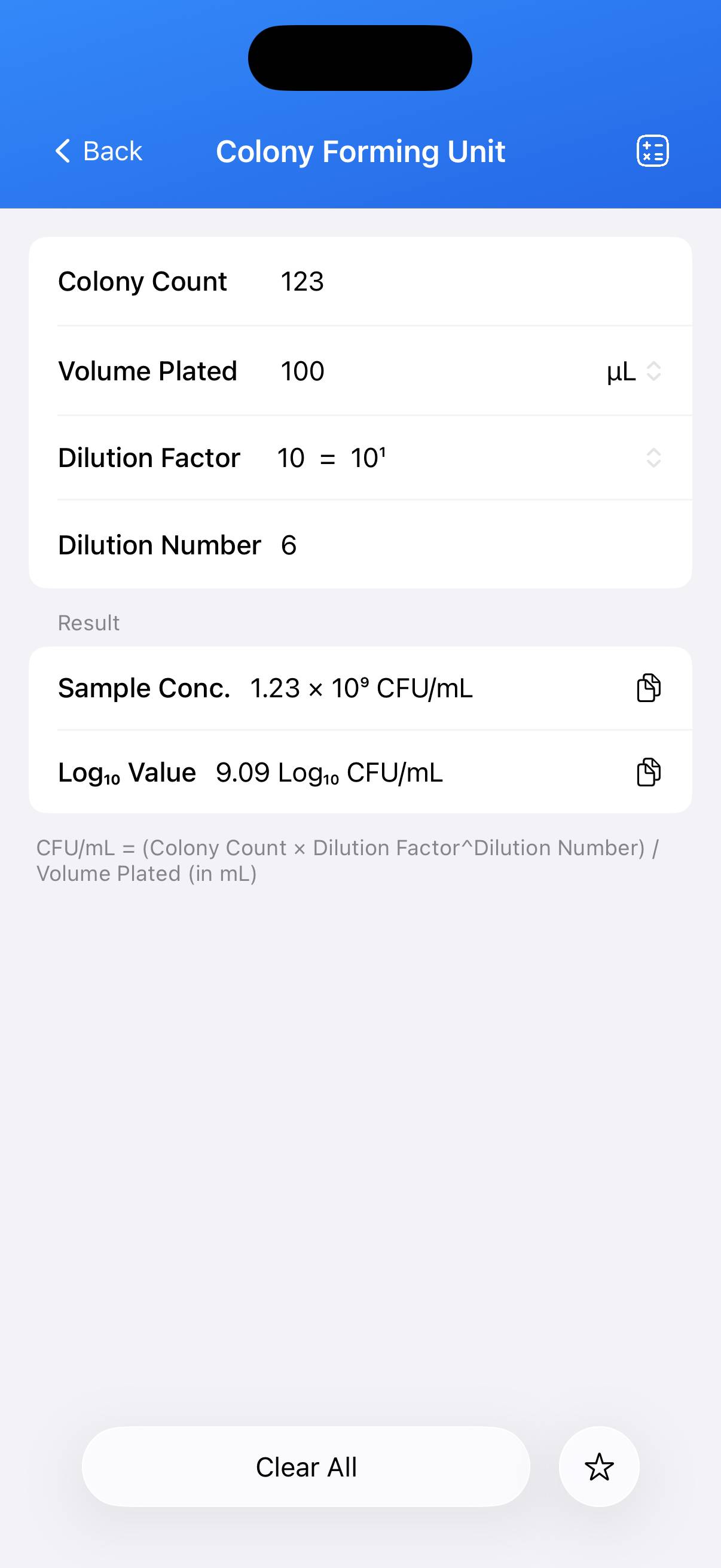
Calculate CFU/mL or CFU/g from colony counts, plated volume, and serial dilution factor.
Handles TNTC and zero-count plates, with clear interpretation for detection limits.
Provides Log10 CFU values and warnings when colony counts fall outside the reliable 30-300 range.
CFU Calculator for Colony Counts
This tool calculates CFU/mL or CFU/g from colony counts, plated volume, and serial dilution factor. It is intended for quick plate count checks in microbiology workflows.
How It Works
Input the number of colonies observed on a plate. You can also handle special cases such as "TNTC" (Too Numerous To Count) or zero colonies. Enter the volume plated and the dilution factor applied. The calculator then provides the concentration in CFU/mL for liquid samples or CFU/g for solid samples.
Calculation Formula
Log10 CFU = log10(CFU/mL or CFU/g)
Features & Warnings
- Provides Log10 value for reporting and analysis.
- Clear interpretation for counts beyond detection limits, including TNTC (> limit) or zero (< detection limit).
- Warnings if your colony count falls outside the standard reliable range (e.g., 30-300 colonies).
Interpreting Plate Count Results
The 30-300 colony range is a practical rule for plate count reliability. Very low counts are noisy because each colony has a large effect on the final CFU estimate, while very high counts can merge or become hard to separate.
TNTC plates should be treated as above the reliable quantification range, not as an exact count. A zero colony plate usually means the result is below the detection limit for the plated volume and dilution used, not that the original sample necessarily contains no viable organisms.
Applications
Useful for microbiology experiments, bacterial or fungal culture monitoring, and standardization of viable counts in experimental workflows.