TCID50 Calculator for Endpoint Dilution Assays
Calculate TCID50/mL from endpoint dilution data for virus stock checks.
Supports the Reed–Muench method (Reed & Muench, 1938) and the Spearman–Kärber method (Spearman, 1908; Kärber, 1931).
Provides infectious virus titer estimates, calculation steps, and practical PFU estimate caveats for experimental planning and virology research.
TCID50 Calculator for Endpoint Dilution Assays
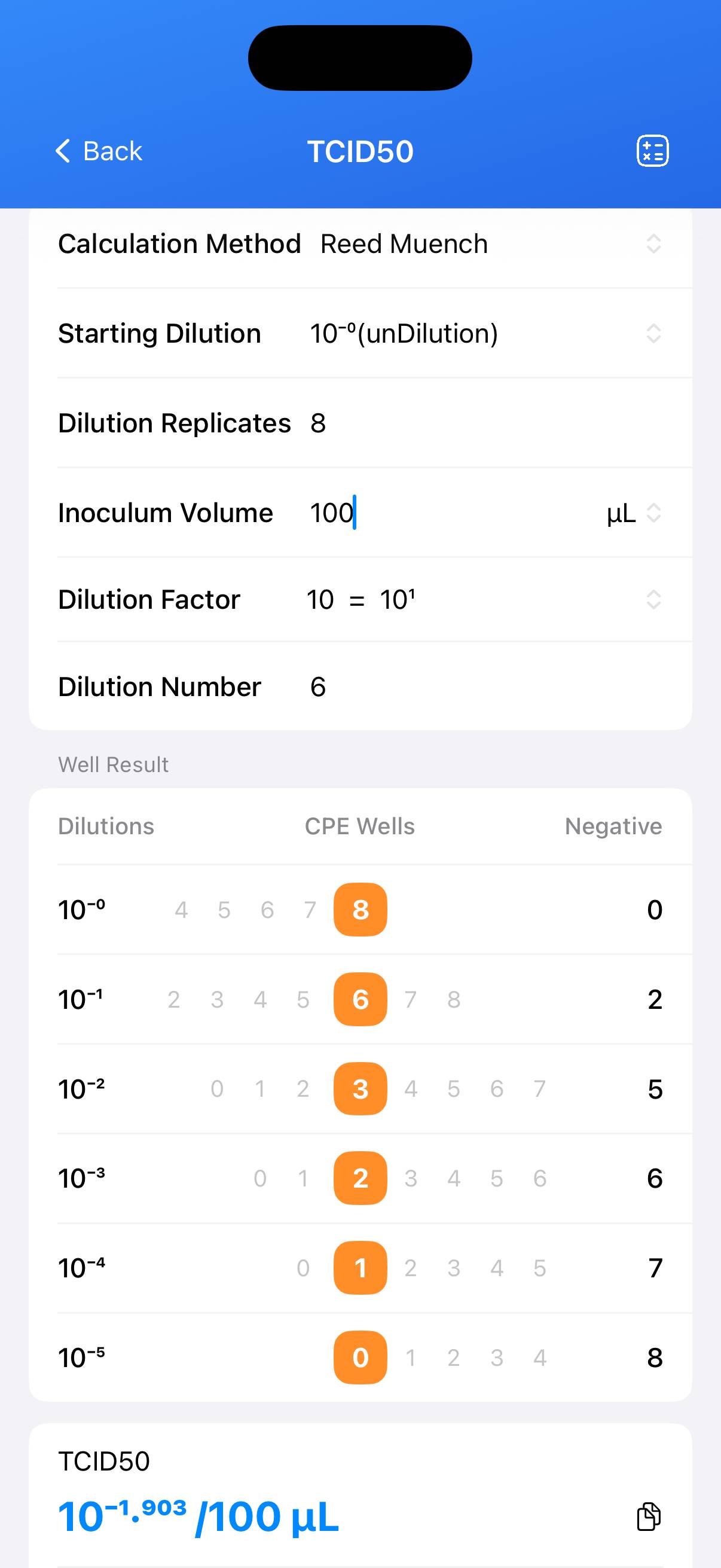
This tool calculates TCID50/mL (50% Tissue Culture Infective Dose per mL) from endpoint dilution assay data using either the Reed–Muench or Spearman–Kärber method. It is designed to reduce spreadsheet friction and improve consistency in routine viral titer workflows.
Why TCID50 Accuracy Matters
Reliable TCID50 values are foundational for viral load standardization, assay reproducibility, and comparing results across experiments. Small calculation errors can propagate into large differences in downstream data interpretation.
Data Input
Enter your dataset including Initial Concentration / Dilution Factor / Inoculating Volume and the number of Positive / Total wells. Ensure that the observed positives are equal or decreasing and that the totals per dilution are identical. You can enter up to 1-10 test sets.
Use consistent dilution steps, confirm scoring criteria (CPE or endpoint), and double-check the highest dilution with 100% CPE before calculation.
If you need a TCID50 to PFU estimate, treat it as a rough Poisson-based conversion rather than a replacement for plaque assay validation. BioCalculator keeps this wording conservative because TCID50, PFU, cell line, inoculation volume, and scoring conditions do not map perfectly across assays.
How to calculate TCID50
Reed–Muench Method
Step one. Calculate infection rate:
Step Two. Identify dilutions above and below 50% positive, then calculate the proportionate distance (PD):
Step Three. Calculate logID50:
Spearman–Kärber Method
Directly estimate logID50 using the following formula:
Key Features
- Flexible Calculation Methods:
Supports both Reed–Muench and Spearman–Kärber methods for comparison and compatibility with lab protocols. - Streamlined Data Entry:
Easy input of dilution series, inoculating volumes, and positive/total wells. - Immediate Results:
Provides logID50 instantly with transparent calculation steps. - Reliable Workflow:
Reduces transcription and formula errors common in spreadsheet calculations. - Practical Documentation:
Encourage recording sample details (strain, cell line, operator, date) for reproducibility.
Applications
- Accurate viral titer determination for vaccine development and antiviral research.
- Standardization of viral stocks across experimental batches.
- Multi-site collaborative studies requiring consistent TCID50 measurement.
Related TCID50 Guides