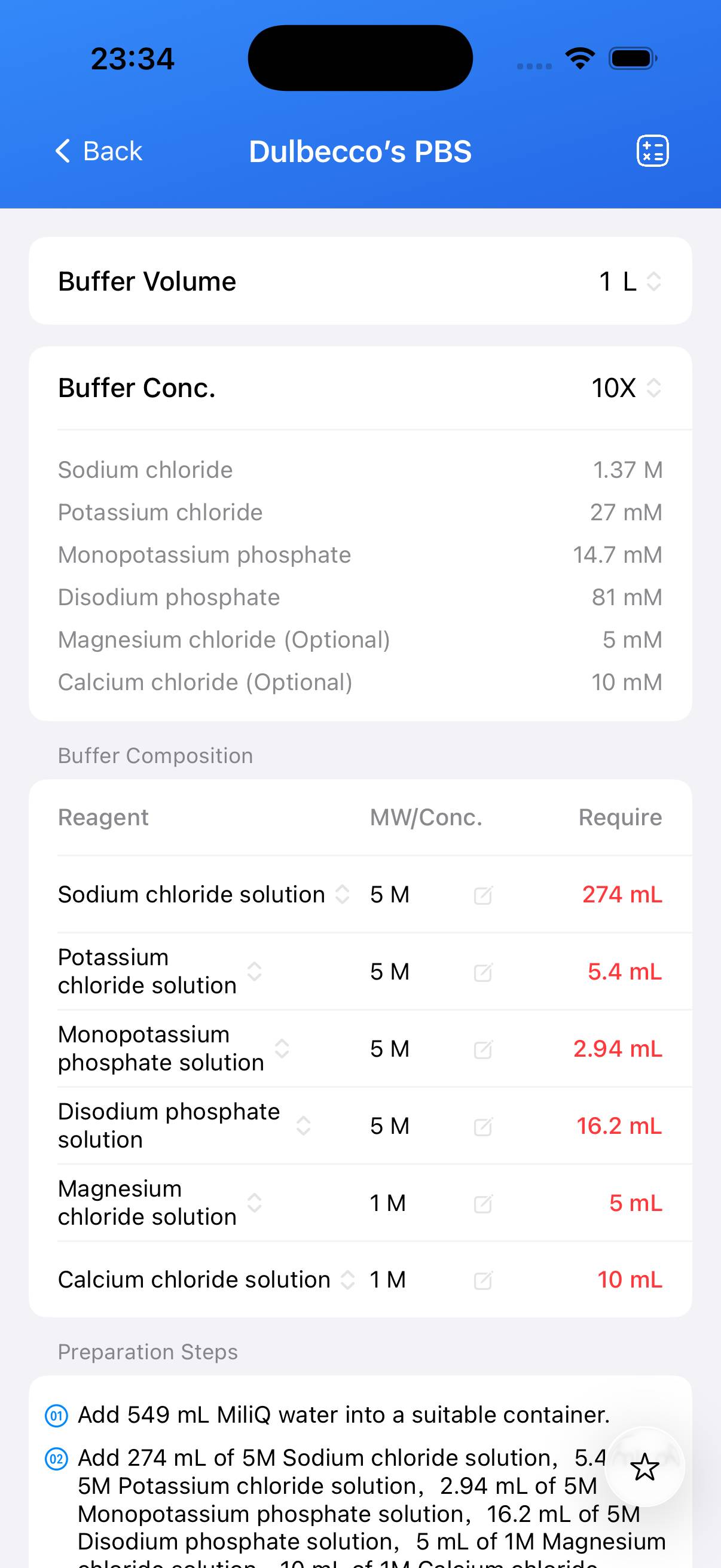
Preparation Dulbecco’s Phosphate Buffered Saline
This guide describes the preparation of Dulbecco’s Phosphate Buffered Saline at a defined molarity for laboratory use.
Dulbecco’s Phosphate Buffered Saline (DPBS) is a modified phosphate-buffered saline widely used in cell culture and biological research, with pH and osmolarity optimized for mammalian cells.
Dulbecco’s Phosphate Buffered Saline (DPBS) – 1X Working Solution Composition
| Name | Formula | Concentration (1X) | CAS |
|---|---|---|---|
| Sodium chloride | NaCl | 137 mM | 7647-14-5 |
| Potassium chloride | KCl | 2.7 mM | 7447-40-7 |
| Monopotassium phosphate | KH₂PO₄ | 1.47 mM | 7778-77-0 |
| Disodium phosphate | Na₂HPO₄ | 8.1 mM | 7558-79-4 |
| Magnesium chloride (Optional) | MgCl₂ | 0.5 mM | 7786-30-3 |
| Calcium chloride (Optional) | CaCl₂ | 1 mM | 10043-52-4 |
Applications of DPBS
DPBS is commonly used for washing cells and tissues, diluting samples, transporting cells, and preparing reagents in cell culture workflows. Compared with standard PBS, DPBS is formulated to better support mammalian cells and is frequently used in cell dissociation, staining, and microscopy procedures.
Preparation Tips, Sterilization, and Storage
- In practice, the pH of 1X DPBS prepared with Milli-Q water is typically between 7.2 and 7.4, and adjustment is usually unnecessary.
- If strict pH control is required, measure and adjust the pH after dilution to 1X.
- Storing concentrated DPBS at 4°C may cause salt precipitation. Shake well before use; discard if particulates remain.
- Anhydrous disodium phosphate is highly hygroscopic; avoid prolonged exposure during weighing.
- The addition of calcium chloride and magnesium chloride should be determined by experimental requirements.
- Anhydrous CaCl₂ and MgCl₂ release heat upon dissolution; handle with caution.
- Sterilization: 0.22 μm filtration or autoclaving.
- Storage: room temperature or 4 °C.
Preview