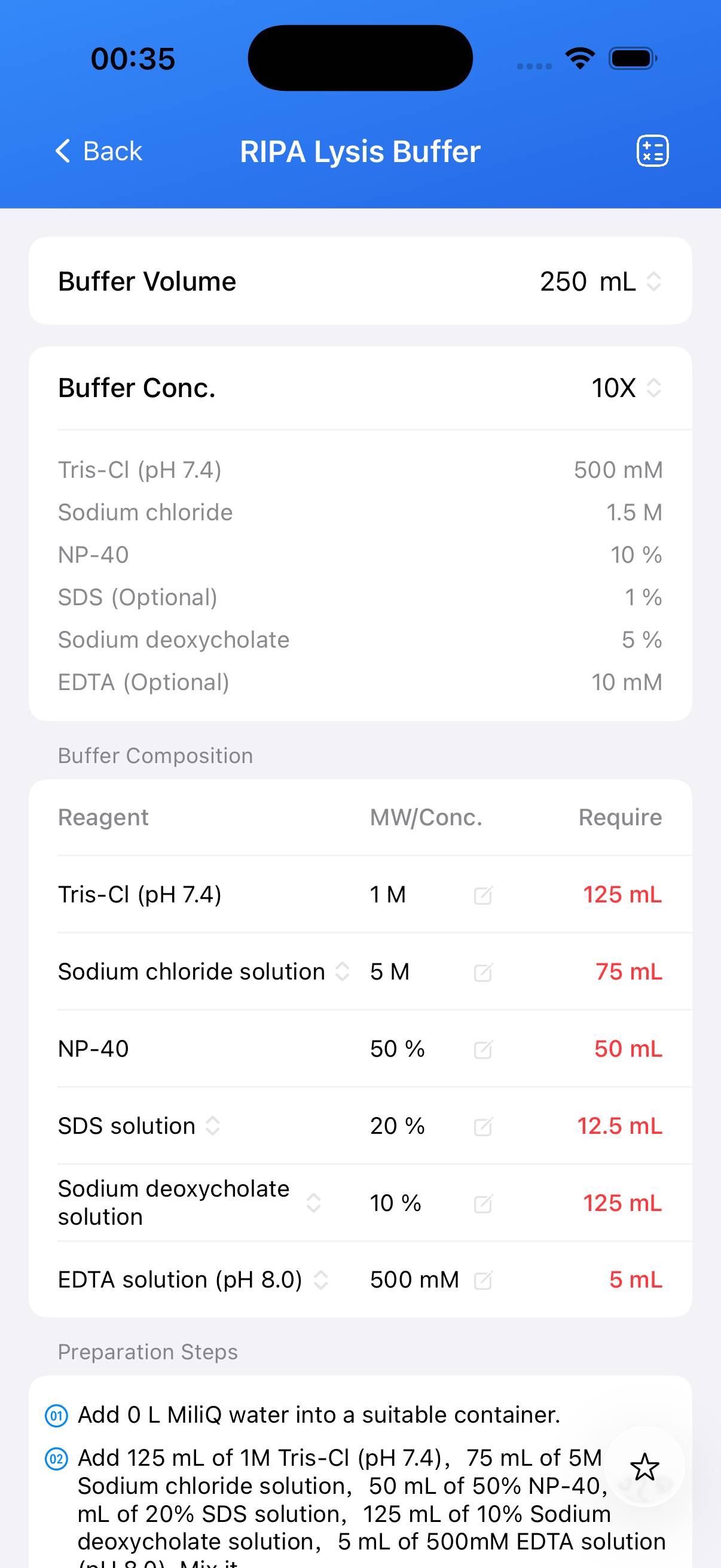
Preparation RIPA Lysis Buffer
This guide describes the preparation of RIPA Lysis Buffer at a defined molarity for laboratory use.
RIPA Lysis Buffer (Radio Immuno Precipitation Assay buffer) is a widely used cell/tissue lysis buffer for extraction of total proteins, including membrane, cytoplasmic and nuclear proteins. Due to its mix of ionic and non‑ionic detergents, it solubilizes proteins effectively while maintaining many antigenic epitopes for downstream assays such as Western blotting and immunoprecipitation.
RIPA Lysis Buffer – Composition
| Name | Formula | Concentration | CAS |
|---|---|---|---|
| Tris‑Cl (pH 7.4) | C₄H₁₁NO₃ | 50 mM | 77‑86‑1 |
| Sodium chloride | NaCl | 150 mM | 7647‑14‑5 |
| NP‑40 | (C₂H₄O)nC₁₄H₂₂O | 1% (v/v) | 26027‑38‑3 |
| SDS (Optional) | C₁₂H₂₅O₄NaS | 0.1% (w/v) | 151‑21‑3 |
| Sodium deoxycholate | C₂₄H₃₉NaO₄ | 0.5% (w/v) | 302‑95‑4 |
| EDTA (Optional) | C₁₀H₁₆N₂O₈ | 1 mM | 60‑00‑4 |
Sterilization & Storage
- Sterilization: Usually not required; buffers containing detergents are typically filtered (0.22 μm) if needed but not autoclaved to avoid degradation of detergents or EDTA.
- Storage: Room temperature or 4 °C; keep working aliquots on ice during use.
Tips & Notes
- Add protease and phosphatase inhibitors (e.g., aprotinin, leupeptin, pepstatin, PMSF, Na₃VO₄, NaF) immediately before use to prevent protein degradation; PMSF is unstable in aqueous solution and should be added just before use.
- Triton X‑100 can be used as a substitute for NP‑40 in some formulations.
- For applications preserving protein–protein interactions, consider buffers with milder or no ionic detergents.
- Sodium deoxycholate concentration may be adjusted (typically in the 0.1–1% range) depending on cell type and lysis strength required.
- Perform all lysis steps on ice or at 4 °C to minimize proteolysis and denaturation.
Preview