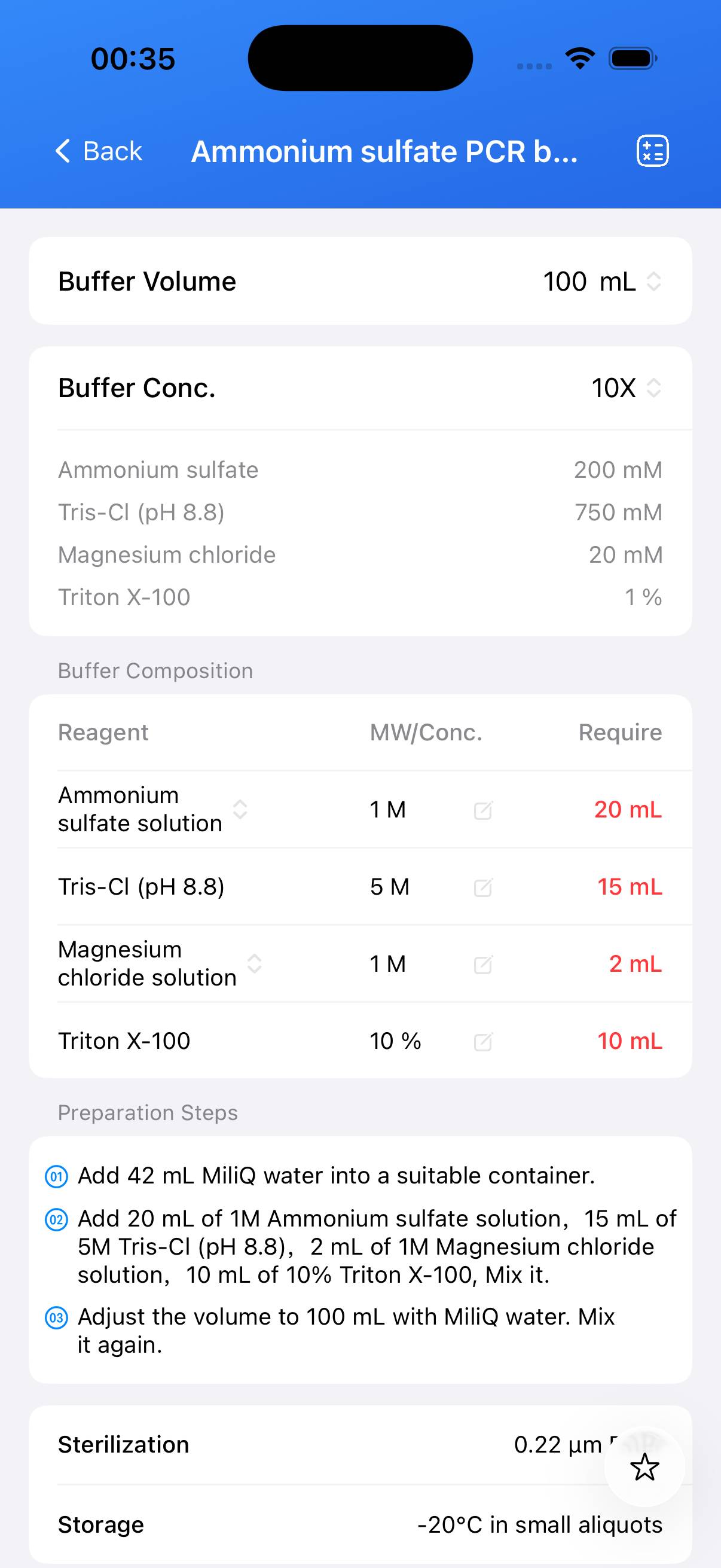
Preparation Ammonium sulfate PCR Buffer
This guide describes the preparation of Ammonium sulfate PCR Buffer at a defined molarity for laboratory use.
Ammonium sulfate PCR Buffer is commonly used to enhance primer specificity and optimize DNA polymerase activity.
Ammonium Sulfate PCR Buffer – Composition
| Name | Formula | Concentration | CAS |
|---|---|---|---|
| Ammonium sulfate | (NH₄)₂SO₄ | 20 mM | 7783-20-2 |
| Tris-Cl (pH 8.8) | C₄H₁₁NO₃ | 75 mM | 77-86-1 |
| Magnesium chloride | MgCl₂ | 2 mM | 7791-18-6 |
| Triton X-100 | C₃₄H₆₂O₁₁ | 0.1% (w/v) | 9002-93-1 |
Sterilization & Storage
- Sterilization: 0.22 μm filtration.
- Storage: Aliquot and store at −20 °C.
Tips
- Buffer pH is usually 8.0–9.5, adjusted by Tris-Cl.
- Triton X-100 is highly viscous; use low-concentration stock or substitute with Tween 20.
- When ammonium sulfate is used, MgCl₂ is typically higher (2.0 ± 0.5 mM).
- NH₄⁺ and Mg²⁺ exhibit antagonistic effects; buffers with ammonium sulfate show higher primer specificity across Mg²⁺ ranges.
- Ammonium ions destabilize mismatched primer–template hydrogen bonds, enhancing reaction specificity.
- Optimal PCR buffer depends on DNA polymerase type; follow supplier recommendations.
- Direct use of anhydrous MgCl₂ is exothermic; add in small portions to partial solvent volume.
Preview